

At first glance, the phrase “the division of Abijah” may seem like a small historical footnote tucked quietly into Scripture. But in the Kingdom of God, there are no throwaway details. What appears minor to us often becomes monumental in God’s redemptive plan. The priestly order of Abijah, to which Zacharias belonged, traces its roots back to King David himself and reveals a breathtaking picture of God’s precision, faithfulness, and sovereign timing, all pointing us directly to Jesus.
David longed to build a permanent house for the Lord in Jerusalem, but God, in His wisdom, did not permit it. David had been a man of war who had shed much blood. Yet rather than growing bitter, David responded with wholehearted devotion. He prepared abundantly for the Temple—gathering gold, silver, bronze, precious stones, and materials in overwhelming measure—so that his son Solomon, young and inexperienced, would not bear the burden alone (1 Chronicles 29:1–5). David also received by the Spirit the detailed plans for the Temple, including not only its structure but the entire system of worship that would take place within it (1 Chronicles 28:12–13). This included the organization of the priests and Levites who would serve before the Lord.
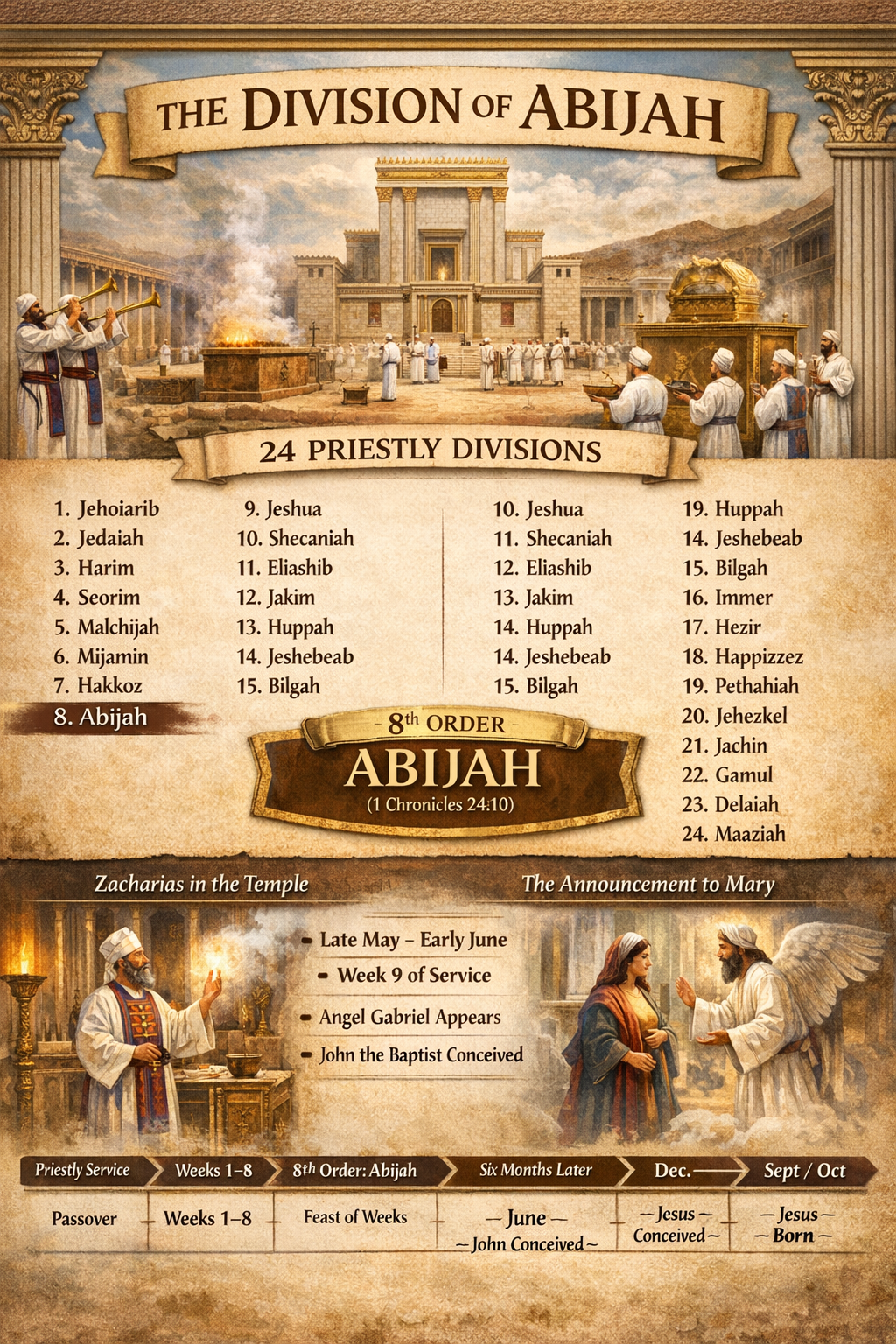
Before the Temple, Israel worshiped in the Tabernacle, a portable, temporary dwelling for God’s presence. But the Temple would be permanent, expansive, and centrally located in Jerusalem. Such a shift required order, structure, and faithful stewardship. The tribe of Levi had long been set apart for sacred service, yet only the descendants of Aaron were permitted to function as priests. The remaining Levites assisted in the care and service of the sanctuary and its furnishings (Numbers 1:50). To ensure fairness and continuity, David divided the priests into twenty-four courses, each assigned specific weeks of service throughout the year. These divisions were chosen by lot, a biblical means of discerning God’s will, underscoring that this was not merely human organization, it was divine orchestration (1 Chronicles 24:4–6). The division of Abijah was eighth in this sacred order (1 Chronicles 24:10).
Each priestly division served for one week at a time, twice a year, except during major pilgrimage festivals such as Passover and the Feast of Weeks, when all priests were required to serve due to the massive influx of worshipers. This ancient schedule becomes critically important when we arrive at the opening chapter of the Gospel of Luke. Luke does not begin with the birth of Jesus, but with the announcement of the birth of John the Baptist. He carefully records, “There was in the days of Herod, king of Judea, a certain priest named Zacharias, of the division of Abijah” (Luke 1:5). This is not a casual detail, it is a timestamp embedded in redemptive history.
The priestly year began with the month of Nisan (March/April). Accounting for Passover and the Feast of Unleavened Bread—during which all priests served—the rotation would have placed the division of Abijah on duty during the ninth week of the priestly year, roughly late May to early June. While Zacharias was faithfully ministering in the Temple according to this ancient schedule established by David centuries earlier, the angel Gabriel appeared and announced that he and his wife Elizabeth would conceive a son, John, who would prepare the way for the Lord (Luke 1:13–17).
Immediately following this service period came the Feast of Weeks, or Shavuot (Pentecost), another festival requiring all priests to remain in Jerusalem (Leviticus 23:15–16). This means Zacharias would not have returned home until mid-to-late June. It is at that point that Elizabeth would have conceived John the Baptist. Luke then gives us another precise marker: “In the sixth month…”—referring to the sixth month of Elizabeth’s pregnancy—the angel Gabriel was sent to Nazareth to announce the conception of Jesus to Mary (Luke 1:26–33).
From this divinely ordered sequence, the timeline becomes beautifully clear. John the Baptist was conceived in late June and born around March or April. Jesus, conceived six months later, would have been born in September or October. This aligns perfectly with the biblical narrative and explains why Scripture never suggests a winter birth for Jesus.
What began as a single phrase—“the division of Abijah”—unlocks a profound revelation of God’s sovereignty. The Kingdom of God does not operate randomly. God was orchestrating events centuries in advance, using David’s obedience, priestly order, and sacred rhythms to prepare the way for the Messiah. The arrival of Jesus was not accidental, symbolic, or approximate—it was exact.
And here is the Kingdom challenge for us today. The priests of old eagerly awaited their appointed time to serve, recognizing the honor and responsibility of standing before the Lord. Today, through Jesus, our great High Priest (Hebrews 4:14–16), every believer has access to God’s presence and a role in advancing His Kingdom. Yet while opportunities to teach, serve, encourage, and proclaim the gospel abound, far fewer step forward.
The story of Abijah invites us not only to marvel at God’s precision but to respond with faithful participation. God is still working according to divine timing. The question is not whether His plan is unfolding, it is whether we will take our place within it.